
Welcome!
Here you will find everything you need from scores to schedules. This page will be updated regularly, so please check back!
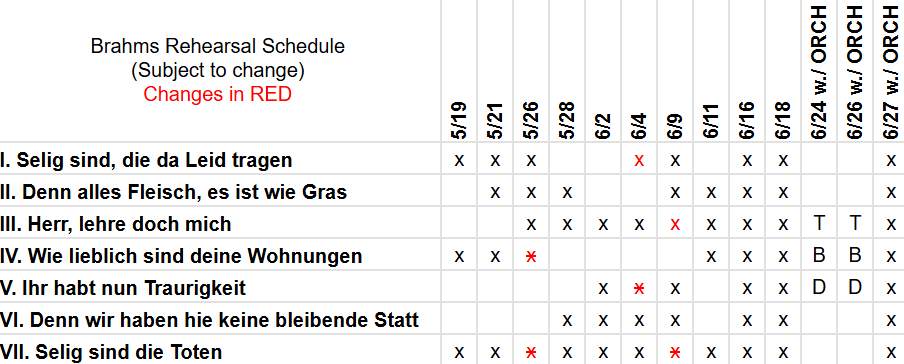
Rehearsal Schedule
(Subject to Change)
St. Benedict R.C Church 1317 Eggert Rd. Buffalo, NY
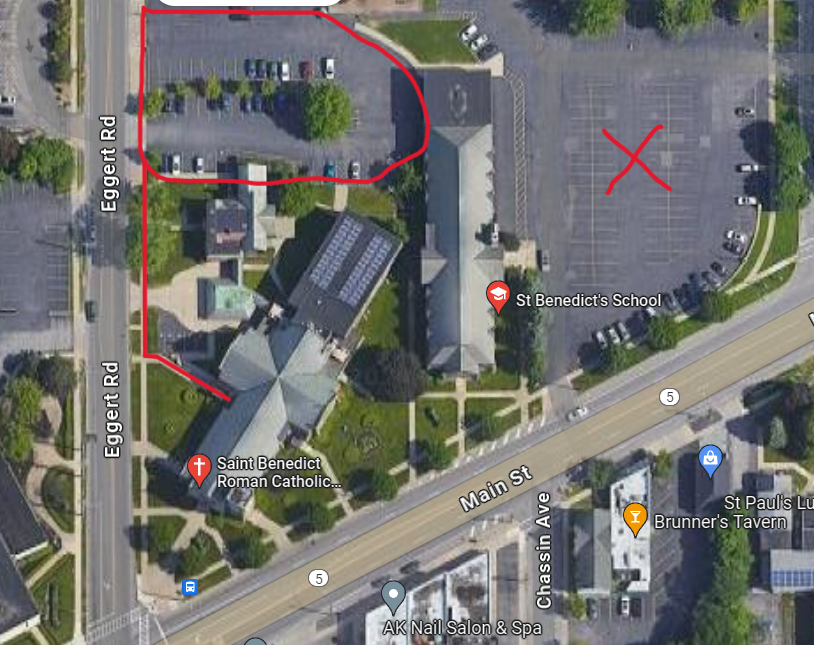
Rehearsals 5/19 - 6/16 will take place at St. Benedict’s from 7-9:30 pm unless otherwise noted. It would be best to park in the circled lot and follow the red line to the side door, which is handicap accessible. For safety, this will be the only door unlocked. The lot marked with an X should only be used for overflow. Directly in front of the accessible door are a limited number of handicap parking spots.
Notes
Check back here for notes posted after each rehearsal - especially if you missed a rehearsal.
Tuesday 6/9
Movements worked on: 1, 2, 3, 5, 6
Overall: Astounding improvement. We added the 3rd movement which was not originally scheduled. We did not get to the 7th movement as originally scheduled.
Movement 1
Excellent - almost performance ready.
Movement 2
For the beginning text an wherever it occurs, “Fliesch es” needs a glottalized “e” so it’s not “Fliesches”
At rehearsal H the “t” on Wort and bleibet still isn’t together. Both should come directly on beat 3 of their respective measures.
Measure 295-296 has a ritard over “ewige Freude”
6 bars before N is an easing into the tranquillo tempo. “rit. al tranquillo” if you will.
The entrances after N can be a little louder. They’re marked “p” but they’re more like section solos.
Basses at measure 317 beat 4 needs to be a more confident entrance.
Movement 3
Just F to the end was run through as a refresher. Getting better every time!
Movement 5
Let the opening “rocking” theme in the accompaniment be your guide. The entire movement should be sung with the act of comforting a child.
Again “p” and “pp” should have greater differences.
Movement 6
The fugue was worked on first. Much easier than the fugue in movement 3 - so rehearsal moved a little quicker.
Dynamics are extremely important here. There is so much forte in this movement that a mezzoforte, mezzopiano and piano should not be taken for granted.
Measures 297-301 and 323-327 should feature the “conversation” between S and T. If you can’t hear it, you’re too loud.
THURSDAY 6/4
Movements worked on: 1, 3, 6, 7
Overall: Attendance was much improved. The sound is filling out quite nicely. We did not get to the 5th movement as was originally scheduled. However, it was done very well on 6/2
Movement 1
Movement 1 was an addition from the original schedule to keep it fresh.
Movement 3
Much work was done on the fugue.
We had a sectional rehearsal - S/A was with Mason and Brad, T/B was with Daniel and Karen.
Movement 6
Focus was on the Vivace to the Allegro(Fugue)
The Fugue was run, but not fine tuned.
Movement 7
Fine tuned from the beginning to measure 100.
Tuesday 6/2
Movements worked on: 2, 3, 6, 7
Overall: Much progress on the 3rd movement. Still very tricky F to the end. Individual work is a MUST for success. At this point, nearly all of the music has been visited in some capacity. The whole work is fair game - nothing should be a surprise at this point.
Movement 3
Lots of work was done on F to the end. The semi-acapella passage beginning in measure 164 is getting tremendously better.
Sopranos - caution not to begin your triplets too soon in measure 166.
Movement 5
The easiest movement in the Requiem. The proof was in the fact that it’s already about 95% perfect from just one rehearsal.
There are only two written dynamics for the choir in this movement - p and pp.
Therefore, p and pp should have a greater impact - make a bigger difference between the two.
Written crescendos should cap off at no more than a mezzo forte (mf)
Movement 6
Attention was focused on rehearsal C through rehearsal D
“zu der Zeit der letzten Posaune” should be essentially memorized so you can watch for the accelerando.
we accel. from C to measure 76 at which point we will be at the tempo of the Vivace (measure 82)
Vivace (m. 82) needs to be exclaimed, like a fanfare. LOTS of space between staccato notes and triplets (sopranos and altos) need to cut through like trumpets.
Movement 7
The focus was on Letter C to measure 100.
As I noted in your score, Soprano 2s are jumping down to the Alto line at m. 84 and jumping back to Soprano proper on beat 3 of measure 89.
This felt very uncertain. Please review it.
Thursday 5/28
Movements worked on: 2, 3, 6, 7
Overall: Progress. Still low attendance because it was the BPC’s last day rehearsing Carmina.
Movement 2
Rehearsed N to the end.
Did a complete run through of the entire movement. Stopping only for major issues.
Movement 3
Reviewed rehearsal F up to the fugue (still one of the hardest places in the Requiem - please review on your own, frequently!)
We started the fugue up to rehearsal H
Movement 6
As an introduction to this very long movement, coupled with the amount of work we did on movement 3, we only rehearsed the beginning to letter A.
The opening should feel almost march-like. With a bounce. Not too slow!
Andante = walking tempo.
Think “Moses leading the Jews, seemingly aimlessly, through the desert for 40 years.”
Where are we going? We have no permanent home? We’re seeking it, wandering.
Movement 7
Rehearsed B to measure 70.
“Ja der Geist spricht” Yes says the Spirit. Should sound almost ghostly, with a Sotto Voce whisper.
Think “breath of the Holy Spirit”
Measure 66-69 is a moment! A beautiful, tender moment.
Sopranos are featured in m. 66
Give the tenors room to resolve the end of m. 67
Altos and Tenors have the spotlight at m. 68-69.
TUESDAY 5/26
Movements worked on: 1, 2, 3
Overall: Due to the late start (7:45pm) we did not get to movements 4 and 7 as scheduled)
Movement 1
The opening chorale is still unstable. It is a capella - please review your part
We’ve come far in this movement with only three rehearsals. We will not see it again until 6/4. Please review and keep fresh.
Movement 2
We worked on Letter H to great success.
Please make sure the Ts on Wort and bleibet come on beat three in measures 200 and 201 respectively. des Herrn WorT, blei-beT.
Measure 206 (Allegro non troppo) “Die Erlöseten” needs space and marcato.
Think jaunty march. It’s the opposite of how you’ve been asked to sing almost all choral music. It’s okay to sing “Die… Erlö…. seten…. des Hern” especially in the Cathedral.
Rehearsal I (m. 219) “hear the tenors”
Rehearsal M (m. 291) “hear the altos”
Any time you sing “wird weg” pronounced “veerd vek” it should be forceful.
Like you’re flicking the notes away. Pain and sorrow will go away! wird wek!!
m. 269 is a tricky canon - especially for sopranos and tenors who are only singing a beat apart. Take careful attention here.
m. 284 (with bass pick up) NOTE: the emphasis is on a different beat each time.
For SAT its 1-2-3-4, 1-2-3-4, 1-2-3-4.
For basses, its 4, 1-2-3-4, 1-2-3-4, 1-2-3-4.
Movement 3
We isolated two of the hardest parts in the entire Requiem.
Rehearsal F “Nun Herr, wess soll ich mich trösten” is a challenging, yet powerful “choral cadenza”.
Slow practice on your own will go a long way here.
We will rehearse this many, many times.
m. 164 “Ich hoffe auf dich” is also extremely difficult and basically a capella with some light brass harmonic accompaniment.
Therefore, it’s best to assume you’re “on your own” here.
Slow practice on your own will go a long way here.
We will rehearse this many, many times.
Thursday 5/21
Movements worked on: 1, 2, 4, and 7
Overall: Attendance is still low (as expected), but improvements are being made.
Movement 1
opening chorale - measures 19 and 20 do not have a crescendo. Maintain pianissimo until m. 21
Rehearsal B “Die mit Tränen” can still be more “sob-like”
Movement 2
Opening - open jaw, make a dark tone
Rehearsal C is okay, it comes rather naturally, but D to m. 103 needs part work/solidification.
We stopped before H
Movement 4
m. 48 verlanget = longing, sehnet = yearning. Sing legato and sing longingly. ver-LAN-get und SEH-net.
m. 124 can still be more marcato, bouncy, almost Baroque signing.
Movement 7
Much improved! We solidified the beginning through m. 34
Tuesday 5/19
Movements worked on: 1, 4, and 7
Overall: Not a bad rehearsal considering we only had about 1/3 of the choir in attendance. Please continue to listen to practice tracks as we don’t have very much time to stop and play out individual parts.
Movement 1
Measures 19-27 need more work in order to sing confidently a capella
Sopranos - measures 24 and 116 - please watch your pitches F-E-D-E, the Es were coming a little flat when sung from F
Measure 154 - everyone should have changed the downbeat to an eight note - making space before the S/A’s “getröstet werden”
getröstet is pronounced geh-trur-stet, not ge-troh-stet
Tränen is pronounced TREH-nuhn, not TRAH-nuhn
Movement 4
Stacking entrances beginning at measure 48 lack confidence. The dynamic is piano, yes - but pitches must be secure.
Measure 124-153 (the most rhythmically challenging part of this movement) needs quite a bit of work. Please solidify your pitches. Tenor and Bass rhythms, especially at measures 143-148.
Movement 7
We didn’t do much work on the 7th but to solidify the hemiolas (triple over duple) in measures 130 and 140. NOTE: They look similar but they are not the same!
Worked on the ending to match the first movement.
Though we sang though the whole movement we didn’t “work on” much more than that.